Why Visit Kourion?
Kourion combines several things that make an archaeological site memorable: impressive ruins, fascinating history, beautiful mosaics, a spectacular theatre and an exceptional setting.
What is Kourion in Cyprus?
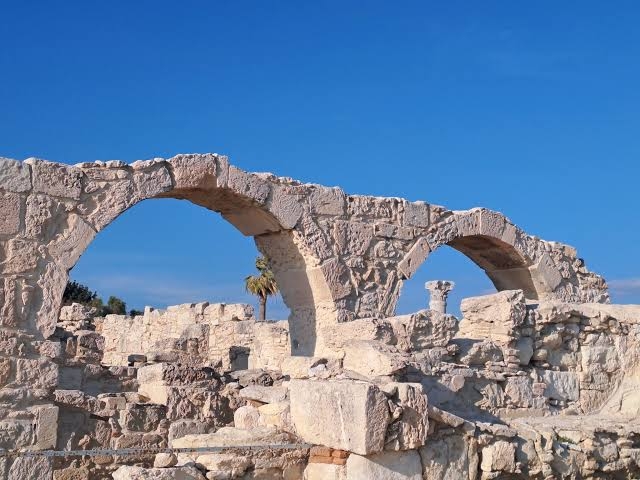
Kourion is one of Cyprus’s most spectacular ancient archaeological sites, occupying a dramatic hilltop position overlooking the Mediterranean west of Limassol. It was one of the island’s important ancient city-kingdoms and developed into a substantial centre with public buildings, villas, theatres and religious monuments. Today, visitors can explore the remains of its Greco-Roman theatre, Roman villas, mosaics, baths, agora and early Christian basilica.
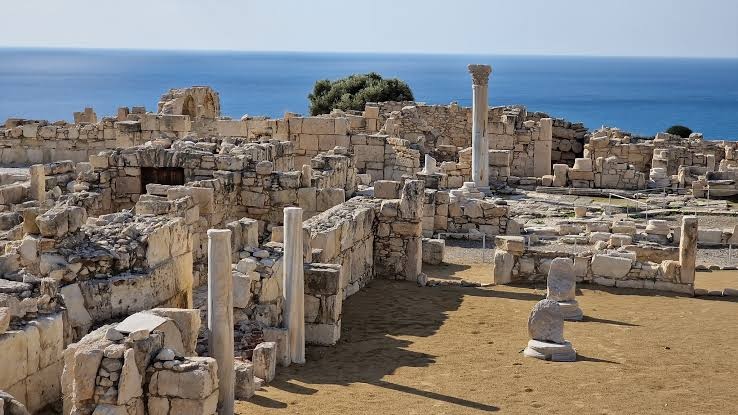
Kourion is particularly memorable because of its setting. The archaeological remains stretch across a hillside overlooking the coast, combining impressive ancient architecture with sweeping views across the surrounding countryside and Mediterranean.
The History of Kourion
Kourion was one of the ancient city-kingdoms of Cyprus and occupied a strategically important position overlooking the fertile valley of the Kouris River.
Archaeological evidence indicates a long history of settlement, while ancient traditions connected the inhabitants of Kourion with Greek origins. Over time, the city came under the influence of different powers that controlled Cyprus.
The city flourished during the Hellenistic and Roman periods, when its buildings and public spaces were expanded and developed.
A major earthquake in 365 AD caused extensive destruction and marked an important turning point in the history of Kourion.
The Theatre of Kourion
The most recognisable structure at Kourion is its spectacular Greco-Roman theatre.
The original theatre was constructed in the 2nd century BC and was subsequently enlarged during the Roman period. It could accommodate thousands of spectators and was an important venue for performances and public entertainment.
The theatre has been extensively restored and is still used for performances and cultural events, particularly during the summer.
Standing among the curved rows of seats, with the landscape and sea beyond, makes it easy to appreciate why the location was chosen. It is one of the most atmospheric ancient theatres in Cyprus.
The House of Eustolios
Close to the theatre is the House of Eustolios, one of Kourion’s most interesting buildings.
Originally a private residence, it was transformed into a public recreation complex during the Early Christian period. The remains include rooms, baths and beautifully decorated mosaic floors dating to the 5th century AD.
The bathing complex provides an insight into the sophisticated facilities available within the ancient city. Visitors can still see parts of the original heating system, including the hypocausts used to circulate hot air beneath the floors.
The House of Achilles
The House of Achilles takes its name from a mosaic depicting the legendary Greek hero Achilles.
The building dates from the 4th century AD and appears to have had an important social or official function. Its mosaics provide another glimpse into the artistic traditions of Roman Cyprus and the popularity of Greek mythology.
The House of the Gladiators
Another impressive villa is the House of the Gladiators, named after mosaics depicting gladiatorial combat.
The scenes provide a fascinating reminder of the entertainment enjoyed by people living in Roman Cyprus. The house itself included an atrium and bath facilities, while earthquakes caused significant damage to parts of the building.
The Roman Agora
The Roman Agora was an important public area of Kourion.
The remains include the foundations and columns of buildings that once surrounded the public space. Nearby are the remains of a Nymphaeum, a monumental structure associated with water and the Roman tradition of public fountains.
Exploring this part of the site helps demonstrate that Kourion was not simply a collection of private houses. It was a functioning city with public spaces, religious buildings and civic facilities.
Early Christian Kourion
Kourion continued to be inhabited after the Roman period and became an important Christian centre.
The remains of an early Christian basilica date from the 5th century and include a separate baptistery. The building is thought to have served an important religious role within the city.
Its presence illustrates how the character of Kourion changed as Christianity became established across the Roman Empire.
The Views from Kourion
One of the things that sets Kourion apart from many archaeological sites is its location.
The ancient city sits high above the coast, providing broad views over the Mediterranean and surrounding countryside. The combination of ancient stone ruins, open landscape and sea makes Kourion particularly impressive for photography.
The setting also helps visitors understand the strategic importance of the ancient city.
Visiting Kourion
Kourion is located around 19 kilometres west of Limassol on the road towards Paphos. The site is open throughout the year, although opening hours vary between the summer and winter seasons.
The Cyprus tourism authorities recommend allowing enough time to explore the wider site rather than simply visiting the theatre. The villas, mosaics, agora and basilica are all worth seeing.
The nearby Sanctuary of Apollo Hylates can also be combined with a visit to Kourion, making this a particularly good area for exploring the ancient history of the region.
For anyone interested in the history of Cyprus, Kourion is one of the island’s essential archaeological sites.
You can stand inside a Roman villa, walk through ancient public spaces and then look out across the Mediterranean from the same hillside. On a clear day you see across the Limassol peninsula and we have even seen the Red Arrows practicing over this area!